Why Don’t I Feel Hungry? How ARFID Confuses Interoception
It’s 5PM and there’s a mild pinch between your eyebrows.
You reach for the Advil to get rid of the pain and light bulb, it’s been hours since your last snack.
We’ve all had times when we don’t feel hunger in our usual way. Maybe there’s added stress, or you’re on a new medication. If you wanted me to eat a meal right before I gave a public talk, my nervous system would give a Hard Pass.
But for some of us, a lack of a strong hunger signal (or, on the flip side, too much signal) can be a bigger part of our lives. Less noticeable or more pronounced hunger cues can point to differences in interoception.
I’ll get into what interoception is in a moment, but the big idea is messages we get from our body’s internal sensory system.
If we haven’t met yet, hi! I’m Melinda Staehling, an Oregon-based Certified Nutrition Specialist and late-diagnosed AuDHDer (autistic + ADHD).
I’m here to help adult ARFIDers and selective eaters feel more connected with their sensory systems and more confident with their food choices.
In this post, we’ll explore the world of interoception—what it is, how we communicate with it, and how we can learn to understand and work with both interoception and ARFID by paying attention to our body’s internal cues.
What is Interoception?
When you think about your senses, you’re probably thinking about the “five” senses: taste, touch, sight, smell, and hearing.
These five senses are the systems that we’re encouraged to develop from a young age, from learning to color with the rainbow of crayons to exploring different textures in the sandbox.
What we weren’t taught about so much, especially if you’re a GenX bebe, were some of the other sensory systems. In fact, I think learning NOT be in touch with these internal cues is baked into our culture.
Ignoring the need to pee is part of workplace culture across healthcare and teaching.
In addition to the five senses, we also have three “hidden” sensory systems. They’re called hidden because someone else doesn’t know what you’re thinking or feeling just by looking at you.
They’re also hidden because we didn’t know as much about them or didn't have the language to describe how important they are until more recently.
The three “hidden” sensory systems are:
Vestibular - Your vestibular system is located in your inner ear and helps to control balance and stability. If you’ve ever been carsick (blergh) or experienced vertigo, you noticed a difference in your vestibular system.
Proprioception - This is your body’s ability to know where it is in space. When you banged your knee on the coffee table when you thought you had clearance, that’s a proprioception difference. On the other hand, playing sports requires a great deal of proprioceptive awareness - you can’t catch the ball if you don’t accurately know where your hands are.
Interoception - This is our body's system of internal physical cues and emotional states. Interoception speaks to both body states and emotional states.
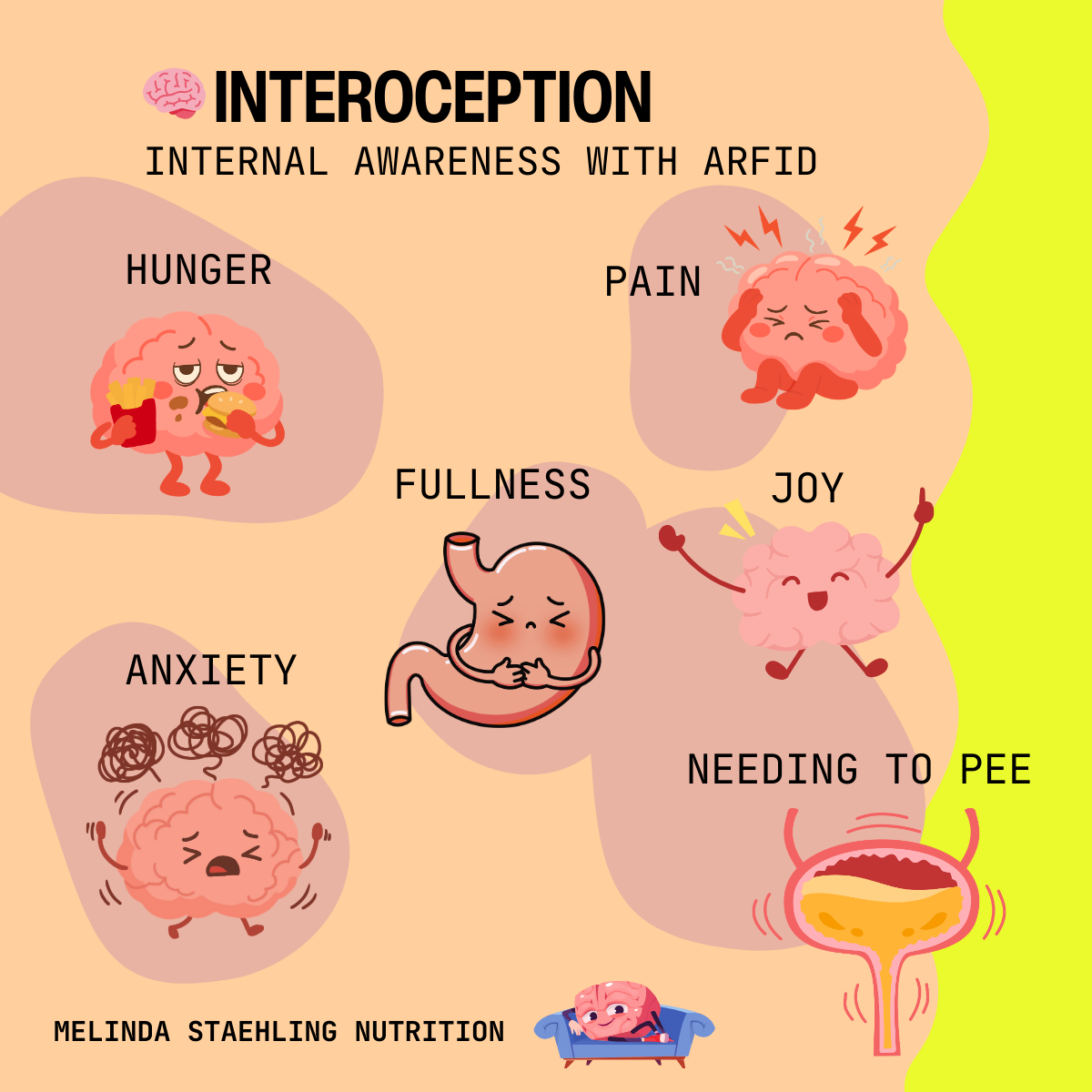
Interoception includes physical sensations (hunger, fullness, pain, needing to use the bathroom) and emotional experiences (the flush of anger, the tightness of anxiety, the lightness of joy).
Here’s the catch: just because your body is sending a message doesn’t mean you can hear or clearly interpret what it's saying.
When people can feel their hunger and thirst cues, or notice when their heart is beating faster or slower, we call it interoceptive awareness.
One way to think about interoception is that the signals begin in the central nervous system. Think about your heart beating, hunger and thirst, temperature changes in the body, or even pain signals. All of these signals originate in some part of the brain. We perceive interoceptive signals in different ways.
When we think about it that way, there are so many health-related and body states that could be better understood with interoception skills.
Here’s a personal example: when I have a migraine attack coming on, the first signals from my body are not always head pain. I have to pee more often, I start yawning uncontrollably, and maybe I feel sick to my stomach. These are interoceptive cues that I am highly attuned to when I have a migraine attack, even before any head pain kicks in.
Over time, and after many mistakes of ignoring cues and pushing through, I’ve learned that these signals are a cue to slow down and do what I need to do to take care of myself.
We can think about hunger cues in a similar way. Stomach grumbling might be the most obvious cue, but maybe your system and wiring are a little different?
With some gentle attention, you can start to connect the dots between changes in your mood and the decrease in your ability to focus that comes before the tummy rumbles.
How do Interoception, ARFID, and Neurodivergence interact?
Autistic, ADHD, and other neurodivergent-identified people often have differences and challenges with interoception. As we’ve discussed, they might feel either too much or not enough hunger.
But for some of us, especially for ARFIDers (Avoidant/Restrictive Food Intake Disorder) or more selective eaters, inconsistent or confusing hunger signals are a daily reality, not an occasional occurrence.
With ARFID, you already know that eating differently from others is part of your experience. Maybe you have a list of safe foods, certain textures give you the ick, or the smell of cooking sends you into overwhelm.
For those with ARFID, how can we lead with self-compassion and curiosity around ARFID and interoceptive differences as a valid part of our identity? I thank the neurodivergent-affirming community and Naureen Hunani, RD, for this reframe: ARFID can be an identity, not a problem to be fixed. Annnd, we can build supports and learn new tools by honoring our safety systems.
In addition to the food experience, ARFIDers often have co-occurring conditions like food intolerances, chronic illness, and chronic pain that can make interoception difficult. This can absolutely impact our experience with connecting and working with our interoceptive cues
What are Some Ways to Increase Interoceptive Awareness?
Next up, I’m going to offer a gentle reframe. Instead of “I’m bad at feeling hunger cues,” can we operate more from the place of “I feel hunger and fullness cues differently, and am learning through process and experimentation to understand myself.”
Understanding Your Interoception “Picture”
One way we can begin building more awareness of interoception in ARFID is by creating a fuller picture of our unique interoceptive cues.
Are you an under- or over-responder when it comes to hunger and thirst?
Do you have different cues that lead you to the sensation of hunger, like getting distracted more easily or having a headache?
Does certain food feel different to you and your body when you are about to eat, compared to when you’re eating? For example, maybe you feel the internal experience of excitement and anticipation of eating a preferred food – that could be stomach grumbling or even butterflies in your chest.
Then, when you actually eat the food (let’s say it’s a chocolate shake), you can feel the cold of the shake in your stomach, the settling of the stomach grumbles
Many ARFIDers relate to the idea of “safe foods” and understand preferred tastes, smells, and textures.
How does this concept compare to your more internal experience of interoception?
Are there certain environments where your interoception experience feels more connected and true? This might be in a specific physical location (like your home or favorite food cart), with certain people, or maybe you feel more connected at a certain time (i.e., morning time is my jam), like when you’re snacking while playing a game.
How to Build Interoception Awareness around Hunger
There are a few ideas to consider when building interoceptive awareness. Sometimes, thinking of these different “buckets” can provide us with structure, so we can meet our needs in different ways.
🪣 Bucket 1: Providing Adaptations and Supports:
We can offer ourselves gentle support and adaptation to help us along our path. Technology can be a great tool for this, like a habit-tracking or timer app, and other ideas might be more obvious but necessary, like leaving your next snack or water bottle by your computer.
Timers, water bottles, smart watches, apps, visual reminders, and cues might be the first momentum toward building a routine that helps you to feel more aligned.
🪣 Bucket 2: Working with Habits:
Habits can support us as we try to build a new routine. Remember that habits are usually very small actions, like getting cereal out of the cupboard, not the entire process, like shopping for a meal.
Connecting new habits to things that already happen without much thought can help them stick.
Building habits usually follows the model of cue > response > reward
Building the habit of making a piece of toast while the coffee brews.
Cue - you start making the coffee (a cue, you already do this daily)
New Response - Now that the coffee is started, you put the toast in the toaster.
Reward - Coffee and toast!
🪣 Bucket 3: Nervous System Supports
Are there any physical items or adjustments that might make the sensory experience of eating and drinking feel safer?
This might mean adjusting the lighting, temperature, textures, and other environmental inputs to create a more easygoing internal experience. Think about the difference between a loud, unfamiliar restaurant and the peace of eating in your favorite cozy place, complete with earplugs. Does your system react differently?
More ideas to build interoceptive awareness:
Before or after eating check-in: Doing a brief check-in before and after eating can help build some of our cues. What do you notice before eating, and after?
Body scans, mindfulness check-ins
Body-based practice like yoga or gentle movement with intention - noticing temperature change, heart rate change, does pain come and go.
Time of day - other activities unrelated to food can give us an “interoception break,” during which we notice certain sensations. How does our internal experience change with hand washing or showering?
Letting go of external pressure to eat “the right way” or the “healthy” way
By working through these different “buckets” of interoception helpers, you can build a stronger toolbox to tap into what you need when you need it.
Interoception Bibliography
Here are a few more resources that I love learning from to understand interoception:
💡 Kelly Mahler: Kelly Mahler, OT, is a dedicated interoception educator and researcher, and has developed many resources to develop interoceptive awareness.
💡 Neurodivergent Insights: Lots more information in this interoception post from Dr. Megan Anna Neff.
💡 Feeling and Body Investigators is a new approach to helping with ARFID. This model was developed for children, who are taught to be “FBI Agents” to discover more about their internal awareness systems.
Enjoy this post? Consider reading:
Finding a Neurodivergent-Affirming Nutritionist or Dietitian
Mindset Shifts & Practical Tips for ADHD Meal Planning
Wrapping it Up:
Learning about interoception can feel like finding a missing piece of the puzzle, especially if you've spent years wondering why hunger and eating feel so different for you than they seem to for others.
Maybe your signals are quiet when they could be loud, or overwhelming when you wish they'd settle down and relax. Maybe you've learned to eat by the clock because your body doesn't give you clear cues at all.
Whatever your experience, know this: There's nothing wrong with you. Your nervous system is speaking a different language, and learning to understand it takes time, experimentation, and a hefty dose of self-compassion.
Consider Interoception, the 8th Sensory System, when working with ARFID and hunger cues.
Create your individual interoception picture.
Build Interoceptive Awareness with a personalized toolkit.
Know that this is ongoing work and lead with self-compassion and self-care.
Thank you for reading. If you would like to personalize your interoception experience with ARFID or selective eating, I’m here to help. Please reach out for a free Introductory meeting