Expert Tips: How to Find a Menopause Specialist
You’re collecting symptoms of perimenopause faster than a puppy slurps up treats. You randomly feel like a walking furnace, your brain is mush, and the soaked sheets are making sleep feel as likely as winning Mega Millions.
What sleep, you ask?
This post is for you when you’re first looking for a menopause hormone specialist and may feel overwhelmed with the options and information. Or, this might be a helpful boost to look for someone new, if you’re not quite satisfied or feeling heard by your current care provider.
If we haven’t met yet, hello there! I’m Melinda Staehling, an Oregon-based Certified Nutrition Specialist and Menopause Society Certified Practitioner. I’m also highly perimenopausal, and sharing my first-hand experience of looking for providers.
While I’m trained in menopause and always learning more, I’m a nutritionist, and therefore, I don’t diagnose or prescribe hormone therapy.
Today, we’re focusing on the people who manage your prescriptions and medical care, and how we can find the best match and partnership to meet our needs.
What does a Menopause Specialist Do?
In this context, a menopause specialist is going to help treat and prescribe hormones related to menopause.
Upon meeting you, a good practitioner will take a careful health history, listen to your symptoms and concerns, make recommendations for menopausal hormone therapy (MHT) if that’s the direction you’re looking to head, or suggest appropriate alternatives. Ideally, these recommendations are consistent with the most current knowledge surrounding hormone therapy and matched to you, the individual.
They should also be able to troubleshoot if and when a part of this picture is not working—traditional menopause hormone therapy of estrogen and progesterone doesn’t always “work” for everyone.
For example, you may have another medical condition that affects how hormones can be safely prescribed.
In the best case, they should also act as a partner in your total health care, working with you to support any primary care concerns and helping you to bolster your team with recommendations that are beyond their area of expertise, just like I’m doing here.
In addition to MHT management, a menopause specialist may also help you find a dermatologist or a new therapist, arrange a DXA scan for bone density, remind you to get a colonoscopy (woo, thanks!), troubleshoot sleep concerns, and/or take care of pelvic exams.
There are a few different specialists who can prescribe hormones, let’s cover those next.
Type of Practitioners Prescribing Menopausal Hormone Therapy
You might find a menopause practitioner to help you with hormone therapy, wearing several different hats. Depending on the state and licensure, they could be:
MD/DO - if your primary care doc has an interest in hormone therapy, rock on!
OB/GYN - This is what most of us think of first. I’d check to ensure they want to work with the menopause population.
ND - A naturopathic doctor can prescribe and manage hormones in some states.
PA/NP/APRN - Physician assistants, nurse practitioners, and advanced practice nurses may all prescribe depending on the level of their training and area of practice.
While I’m mostly talking about providers that treat and prescribe menopausal hormone therapy (MHT) today, other specialties and modalities fall under this umbrella as well.
Alternative Treatments to Menopausal Hormone Therapy
Suppose traditional MHT is not the right fit for you.
In that case, there are other options available your provider might offer, especially for symptoms like hot flashes and night sweats:
Medications (fezolinetant, elinzanetent, SSRIs)
Therapeutic modalities (like cognitive behavioral therapy/CBT for menopause and clinical hypnosis)
There are additional options for bone health and osteoporosis.
Providers trained in sexual medicine and therapy might help troubleshoot libido from a more holistic view, and pelvic floor specialists are there to help with tense or lax muscles that might contribute to symptoms. It can take a village (and you deserve to feel your best).
What are Menopause Society Certified Practitioners (MSCP)?
The first place I recommend you visit when shopping for a new practitioner is the Menopause Society website. You can use their tool to look for a Menopause Society Certified Practitioner (MSCP) near you, who, hopefully, accepts your insurance.
Keep in mind that most/many MHT pieces can be managed through telehealth. If you don’t find a provider in your immediate area, consider expanding your search to your entire state. Most often, licensure works on a state-by-state basis, so looking to larger metro areas can be helpful.
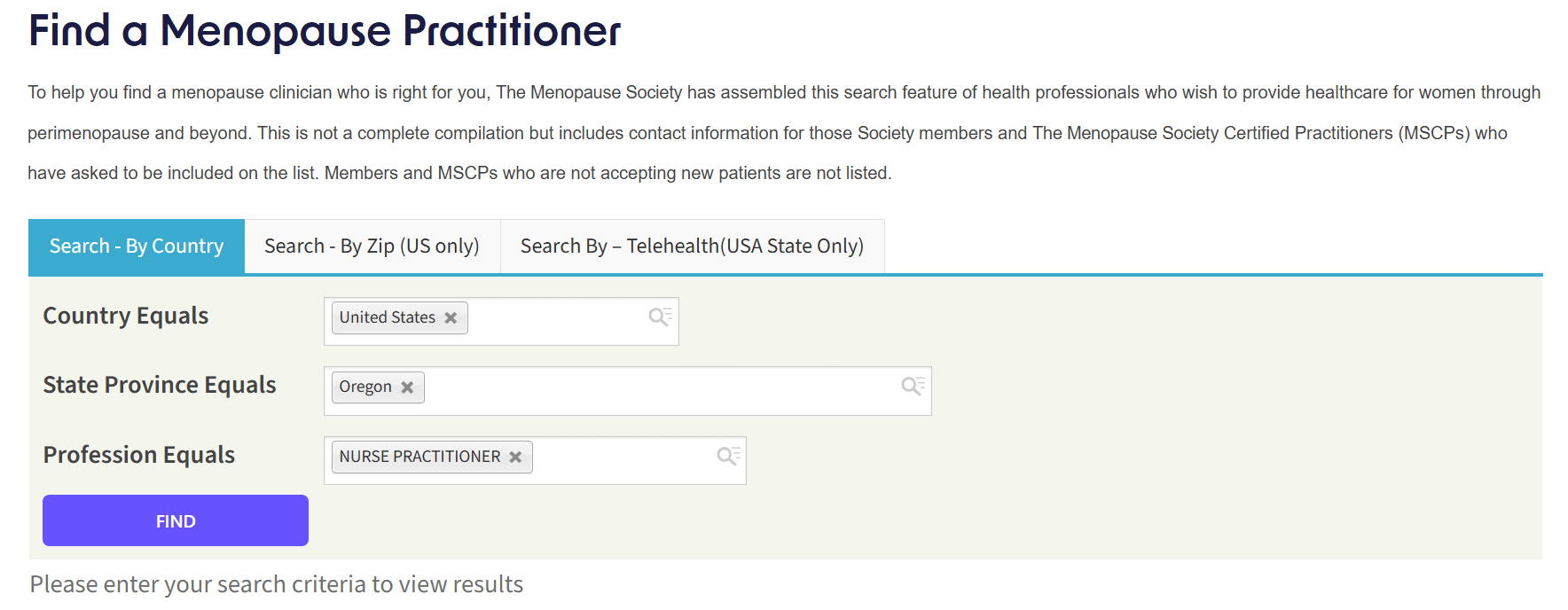
The Menopause Society Search Tool - lots of different practitioner types here, not just OB-GYNs!
The Menopause Society (formerly the North American Menopause Society, or NAMS) is the leading organization in the United States and North America for research, connecting knowledge, and advocacy for care.
There are other menopause societies, such as the International Menopause Society and the Endocrine Society, as well as the British and Australian Menopause Society, which all provide helpful guidelines. However, the Menopause Society is likely to be the most common and relatable source of information in the US.
The Menopause Society Qualifications & Exam
To become an MSCP, you first need to be a licensed healthcare provider (which includes therapists and nutritionists, like me).
Next, you need to pass a 100-question multiple-choice exam. There is no set reference material for the exam. To study, I used a combination of the Menopause Society textbook and other resources the Menopause Society provides to its members. I also read a ton of Dr. Jen Gunter’s Substack, The Vagenda, to keep the information fresh with some slightly less sciency writing.
I sat for the exam for the first time in October ‘24 and DID NOT PASS. I missed it by 3 points. Sobs in pillow.
After sulking for a few months, I dusted myself off and tried again (cue Aaliyah) and passed in June of 2025. I found a great study buddy and spent many nights and Saturdays skilling up, learning the ins and outs of hormone therapy and gaining a broader understanding of midlife health.
Other Options Besides Menopause Society Certified Practitioners
If you don’t find someone who’s an MSCP near you, that's totally fine. There are many, many great providers that do not carry the certification. Searching for “Menopause Specialist near me” may yield a wider range of options.
There is also a large group of online providers, like Gennev, to check into, who may accept your insurance. More on this below. I started with one of these services. There are numerous opinions about these companies and their handling of prescriptions and insurance billing, if you poke around in the Reddit thread r/menopause.
Gentle reminder: when you see someone who is “certified” in menopause or “menopause trained,” I would ask them where they received that training and what it encompassed. There is good training out there, but a reminder: literally anyone can slap together a one-day certification and claim it as legitimate.
My Personal Journey with Menopause Practitioners
My journey with menopause practitioners has been a bit of a winding path. While my symptoms started out with a bang, my provider experiences working specifically with MHT have been pretty good-to-great. I have plenty of disastrous provider appointment stories to share during coffee time, just not in this arena.
And I know, from listening to friends and working with clients, that this is not everyone’s experience. It's tough to leave an appointment feeling like your concerns were dismissed, and you weren’t heard.
A few things to mention as my starting place in all of this. In my personal life, as a patient with some complex medical needs, I’ve learned a lot about how insurance works. Because of my job and skillset, I can speak to providers in their vocab. I have extensive knowledge of insurance billing from running my own private practice.
I also have access to commercial medical insurance, which expands my options for specific providers. I say all of that as a precursor because I know we’re not all starting with the same skills or support.
My first visit to a menopause provider was in early 2023. I was having increasing mental health symptoms of depression, anxiety, and mood swings. Hello, uncontrollable crying jag on an otherwise pleasant walk by the ocean.
I felt totally out of place, out of myself, and my body. Even during the tears, like during the ugly-cry, another part of me would be thinking, “Well, this all feels really weird, and sort of unnecessary.”
The intensity of it all was totally different from my personal norm. My periods were still relatively usual in timing. I had occasional night sweats, but that had been going on for years.
It finally hit me that this was perimenopause.
In my case, I could have easily presented at a GP's office, and I might have been offered psych meds (no shame there, they may have helped), but I made an appointment with an online menopause provider, Midi Health. No relationship or affiliation, that’s what accepted my insurance and was on my radar.
Meeting with my provider online for the first time, and after going over my health history, she prescribed the lowest dose transdermal estrogen patch and a progestin (norethindrone) to go with it.
I remember being really surprised when the pharmacist called my progesterone “birth control” at the counter. I didn’t need birth control; I wanted hormone therapy! In retrospect, I think she was doing her best trying to offer both pregnancy protection and a progestogen. It would have been nice if she had gone into more explanation about why she made her choice, because until I looked for more information, this recommendation confused me.
My Second Visit with a Menopause Specialist
My second visit came about because we had moved states, and I simply needed a refill for what was already working. I tried using the online service ZocDoc, which connects local practitioners to patients. The ZocDoc service was fine, but they hooked me up with another third-party provider who immediately charged me the full cost of the visit and did not even try to bill my insurance and charge me the appropriate copay. I was so annoyed (hello, peri) and I called and messaged a zillion times and never got my money back. Ugh.
The provider, on the other hand, was freaking awesome.
I was a little nervous because when I scheduled, I noticed he was, well, a dude, and how much could he possibly know about MHT and women’s health? A lot, it turned out. And whatever PA school he had attended had trained him well; he had so much information to share.
I only saw this person once, after getting my refill and being burned by the billing, but it definitely had an impact on me.
This appointment was the turning point that made me really want to dig deep into menopause and become an MSCP.
My Current Menopause Specialist
After settling into my new town of Bend, Oregon, I began to look for a local provider. I was hoping to find someone in person, that was more connected to the community for referrals, and also so I could take care of things like pelvic and breast exams, along with managing my MHT.
At my first visit, I was pleasantly surprised to find someone who was smart, informed, detailed, and, bonus, felt like an actual human that I could relate to.
She immediately suggested a few helpful tweaks to my regimen based on our initial conversation. We switched that norethindrone (a progestin) to Prometrium (progesterone), and that really helped with some of the bloating I was experiencing.
She had just passed her MSCP exam with the Menopause Society, and I told her how I hoped to earn that certification one day.
I think the moral of this story if I can offer one for you, is that you’re not married to a provider that you don’t feel you’re getting your best partnership with. I know it’s a pain in the ass, but you deserve to get the best from the time and money you’re investing.
Red Flags and Green Flags: What to Look For in Menopause Hormone Specialist
We’ve all heard the horror stories. Some providers simply do not want to manage menopause or work with the complexities of this population.
Honestly, I think this is fine.
But (big but!) what really burns my toast is when people go to their appointment and are met with misinformation (this is dangerous) or dismissed (your symptoms aren’t real) and not given a proper referral to someone who will actually help.
While you don’t need to know every detail of hormone therapy, it is helpful to know a few menopause and hormone therapy basics.
MORE TO READ: If you need a refresher on the Stages of Menopause, explore this post.
Here are some ideas that might be helpful when searching for a new provider:
Red Flags:
🚩 Prescribing estrogen for people with a uterus without a prescription for progesterone or appropriate alternative.
🚩 Offering estrogen therapy without taking a thorough health history to check for contraindications.
🚩 Offering pellet therapy, either estrogen or testosterone. No menopause society supports this method of delivery for MHT.
🚩 Prescribing testosterone without a serious conversation about the actual benefits in the research, and the potential adverse effects. I might also say refusing to prescribe testosterone without a discussion about the possible benefits.
🚩 You feel rushed, brushed off, or dismissed.
Green Flags:
✅ Checking in on mental health.
✅ Asking about genitourinary symptoms: Vaginal dryness, peeing your pants, UTIs, and offering care like vaginal estrogen.
✅ Primary Care: Making sure you are in good hands with primary care needs, especially heart health, and that you have a supportive team.
✅ Asking permission before getting weighed or talking about weight (more about weight-inclusive providers, below).
✅ Checking in on nutrition and referring out to licensed RDs/Nutritionists (hey, that’s me) when people need help with food and nutrients, which is most of the population.
What if I want a Weight-Inclusive Menopause Specialist?
I’m going to say it plainly. Finding a menopause provider who understands weight-inclusive care and is actively unlearning the weight stigma and anti-fat bias taught in medical school is not going to be easy.
At the very least, you should not feel obligated to be weighed at the appointment if you don’t want to.
DEFINITION Weight-Inclusive: Weight-inclusivity is a framework that prioritizes health and well-being without emphasizing weight. A weight-inclusive perspective challenges the idea that there is a specific body size related to health.
I feel strongly that any conversation about weight loss and/or weight loss medication should be coming from a place of mutual trust, respect, and informed consent - no care provider should assume that you want to change your weight - not all of us do.
As I mentioned above, when I was at the beginning of my journey of finding a provider, I went to one of the bigger online menopause hormone services, and it was fine for then.
However, many of these online, venture-capital-funded menopause providers are now also offering GLP-1s and weight-loss services. While some of these companies are more transparent about what they offer patients, weight loss is a component of most of their programs. It’s a tough mix.
Here are some options of wording to use if you’re looking for a weight-inclusive provider or would like to have a conversation about taking weight at an appointment:
❤️🔥 This Instagram post about advocating prior to an appointment by Sharon Maxwell
❤️🔥 This post on declining being weighed:
❤️🔥 These resources from the Health at Every Size® (HAES®)
MORE TO READ: My thoughts on weight-inclusive menopause nutrition.
Where to Begin: Finding a Menopause Specialist
You deserve a trusted team member to partner in your care. Take the following steps to find your menopause specialist:
Start your search by looking for Menopause Society Certified Practitioners, either local or in your state.
Expand your search with other qualified local providers, women’s health groups, and specifically, “menopausal hormone therapy near me,” which can also provide good results.
Be aware of the menopause hormone therapy (MHT) basics and know your personal 🚩 Red Flags and ✅ Green Flags.
If it’s your priority, create a pre-appointment plan for weight-inclusive care.
I hope this helped with some ideas and conversation to begin your search for a menopause specialist. If you’re looking for support with menopause nutrition, I’m here to help. You can book a free Introductory Call with me to discuss your goals, challenges, and the type of support that feels right for you. Book your Introductory Call, here.