What To Do For Hot Flashes (that’s not hormone therapy)?
You’re two miles deep into a dimly lit tunnel and trip over a rock, face-planting in a tepid puddle. Even the walls are sweating in this space, and the light to safety is far, far away.
Jolting awake to find your sheets soaked, a once-cozy tee now a clammy mess. Instead of the deep, restful slumber you deserve, you peel yourself out of bed and deal with the night sweats routine.
Washcloth, change clothes, look at the clock in hopes of getting back to sleep before dawn.
If we haven’t met yet, hello, hi! I’m Melinda Staehling, an Oregon-based Certified Nutrition Specialist® and Menopause Society Certified Practitioner, and your highly perimenopausal co-pilot on this hot flash and night sweats experience.
Below, we’re looking at what actually happens during a hot flash/night sweat, the current evidence for and against some treatments, and how we might apply this information to our lives.
These are the ways we might, or might not, manage hot flashes and night sweats if and when we don’t want or can’t utilize MHT (menopausal hormone therapy). This post looks specifically at the non-hormonal options for vasomotor symptoms (aka hot flashes and night sweats).
As a weight-inclusive, licensed nutritionist, I have a unique perspective on the nutrition and supplement options.
A reminder, I’m definitely not a Doctor! And while I’m a nutritionist, I’m not your nutritionist, so always check with your healthcare providers before making changes to your plan.
Hot flashes and night sweats are the common bond of the menopause experience. Almost everyone (estimates range up to 80% of people across the menopause transition) has them to some degree, but the frequency and severity can vary widely from person to person.
I have night sweats at different points throughout my cycle, which are super annoying (see dark tunnel dream), but daytime hot flashes, not as much. I think the hot flashes are pretty well controlled with the hormone regimen I’m on.
At the more challenging end of this spectrum, people are experiencing upwards of 40 hot flashes a day—yikes—you can see how that will affect every aspect of life.
Hot flashes take no prisoners, from mood to stress and anxiety to sleep.
What Causes Hot Flashes & Night Sweats?
The physiology of vasomotor symptoms (the combined term for both hot flashes and night sweats) isn’t totally worked out.
Still, we know that, with the drop in estrogen and rise in FSH during perimenopause, we also see changes in the hypothalamus, the brain's temperature controller. In the hypothalamus, there’s a group of neurons –the KNDy neurons (kisspeptin/neurokin B/dynorphin, pronounced “candy”) that are part of this temperature regulation process going haywire.
Let’s explore the most common treatment.
Hormonal Recommendation for Vasomotor Symptoms
Because we’re focusing on non-hormonal options today, I’m going to do a super speedy walk-through of menopausal hormone therapy (MHT) for vasomotor symptoms. There is sooooo much nuance that can (and should) go into this conversation.
You can read more about that in this Menopause Society paper on MHT.
MHT is the gold standard for the treatment of vasomotor symptoms. Consistent doses of systemic estrogen therapy (most often with a complementing progesterone to protect the uterine lining) have the most evidence for controlling these highly annoying menopause symptoms. This estrogen could come in many forms, from a patch to a gel to an oral tablet.
And, not everyone can or wants to use estrogen therapy.
Here are a few reasons you and your healthcare team may choose to avoid adding estrogen.
Reminder, this is all very personal and up for discussion between you and your team.
Update 8/26: I’ll add that it takes a highly skilled and knowledgeable practitioner to have the full conversation about MHT if you’re also working with any of the contraindications below. There are cardiovascular risks to ongoing hot flashes, too, so it’s really a personal conversation, taking into account your whole story/history.
The Classic MHT Contraindications:
Abnormal genital bleeding
History of breast cancer
Estrogen-dependent neoplasia
Active/History of deep vein thrombosis, pulmonary embolism
Recent stroke or heart attack
Liver disease
Known or suspected pregnancy
Hypersensitivity
Porphyria cutanea tardis
READ: Looking for a provider to discuss MHT? Check out my post about finding a menopause practitioner, HERE.
What are the Non-Hormonal Recs for Vasomotor Symptoms?
Now that we’ve settled what VMS are and estrogen therapy as a common treatment, let's take a look at all the other ways we may or may not manage VMS.
I’m going to use the Menopause Society’s Nonhormone Therapy Position Statement of The North American Menopause Society as our North Star and guide here. This is a free resource available to the public. Even if you don’t read the whole thing, I recommend downloading it for reference.
First up, I want to show you the evidence levels used by the Menopause Society in this paper. By starting here, we can look at some of the recommendations and what’s not recommended, and the “Why” behind the decisions.
Evidence Levels:
Level I: good and consistent scientific evidence
Level II: limited or inconsistent scientific evidence
Level III: consensus and expert opinion
We’re going to get into this a little farther down the page.
Recommendations for Vasomotor Symptoms
So here’s what's recommended for treatment, and I want to point out that we have two strong contenders for behavior-based interventions, CBT and clinical hypnosis, with “Level 1” evidence, at the top of the list.
Level I
Cognitive-behavioral therapy
Clinical hypnosis
SSRIs/SNRIs inhibitors
Gabapentin
Fezolinetant (Veozah)
Elinzanetant (Lynkuet)
Level I-II
Oxybutynin (Ditropan, Oxytrol, Gelnique)
Level II-III
Weight loss - but we all know that’s bullshit see below
Stellate ganglion block
Cognitive Behavioral Therapy for Vasomotor Symptoms
Cognitive Behavioral Therapy for Menopause (CBT-M) is a program that mostly measures impact on VMS, and also touches on stress, mood, and anxiety in menopause. This is a plan that includes education and examining our current thought and feeling patterns around VMS and how we might change our thinking.
The CBT studies are particularly cool to me because, unlike clinical hypnosis, you don’t need to meet with a practitioner to see benefit. There are workbooks, books, and apps that also do the trick.
The “therapy” comes from learning what actually drives the hot flashes, and then working with the thoughts and emotions, especially stress and anxiety, and possible embarrassment from being seen while soaking wet from a hot flash at work.
You’ll see in the “not recommended” section down below that paced or controlled breathing on its own is not necessarily recommended for hot flashes, but when included as part of the bigger CBT landscape, it is.
My notes: There’s often weight loss and diet stuff baked into the CBT curriculum, so be aware that you might come across that in these programs.
I know that CBT isn't the favorite therapy modality among the neurodivergent community. And, I think there’s some merit in getting more VMS physiology education, and in examining how our social/cultural emotions might be contributing to worsening symptoms.
Clinical Hypnosis for VMS
In short, clinical hypnosis takes place in a session, so you need a trained clinician to help you along. It involves hypnosis to a very relaxed state, and personalized guided imagery and then self-practice. At the 12-week follow-up in one trial, the reduction in hot flashes was 56.86% for clinical hypnosis and 9.94% for controls.
I’ll stop there, but wow, how cool is the brain that this actually works for VMS.
Old and New Medications for VMS
The medications gabapentin and SSRIs (meds like paroxetine, escitalopram, citalopram, venlafaxine, desvenlafaxine) have been around for a long time, and both are widely available for many people on a range of insurance plans at good price points (yay, accessibility and options!).
I want to point out two new medications, Fezolinetant (brand name Veozah) and Elinzanetant (Lynkuet).
These are both newly approved and to market; Elinzanetant was approved in October 2025.
They both focus specifically on the neurons driving the hot flashes. It’s amazing that we have medications to target these pathways, which will open up so many options for people who aren’t able to take MHT. I don’t know how accessible these are with insurance plans. I’ve heard a range of prices and stories from clients and in the menopause forums.
Will Weight Loss help lower Hot Flashes & Night Sweats?
As a weight-inclusive provider, I find the weight-loss “recommendation” frustrating because the evidence supporting it isn’t as strong as that for the other recommendations.
Remember back to our Levels of Evidence, weight loss is a Level II-III, meaning this recommendation is based on “limited or inconsistent evidence” and “consensus and expert opinion.”
So…what evidence, I ask? I work from the lens that the field of medicine is biased toward managing the bodies of higher-weight people and weight loss. I speak about this elsewhere on the blog, and I think an incredible resource to look to around medical bias and anti-fatness is the work of Ragen Chastain.
Here, they’re looking at evidence that points to higher-weight people having more and more intense hot flashes, but on the flip side, we don’t necessarily have evidence that VMS actually reduces or changes when the same people lower their body weight.
And then my question is: how exactly are people going to lose that weight safely and for the long term? I know that’s a very personal question that I can’t answer here today. But if we follow that trail with the available options like diet, lifestyle, and medications, I want to know what’s actually going to “work.”
My next point is to look at the actual research/evidence they’re using in the position statement that encourages weight loss. One study was a pilot study with 20 in the control group, and the other was a side-arm study on urinary incontinence, in which the women knew they were in the treatment group.
Stellate Ganglion Block for Vasomotor Symptoms
Stellate ganglion block is another Level II-III treatment, and is a nerve block injection into the cervical spine. This is a treatment that is used in pain management, migraine, and has emerging evidence in Long-COVID management. There are “associations of risk” and adverse events according to the Menopause Society; this treatment should come with a careful evaluation of benefit vs. risk.
Wrapping up this section on recommendations, the thing I appreciate most is that we have a menu of options, from behavioral health to medications. The science is still new, and I think we’ll make so much progress here over the next few years, especially as these medications become more widely available. Watch this space!
Non-Hormonal Treatments That are NOT Recommended for Vasomotor Symptoms
I’m using the language here of the Menopause Society paper, which is “not recommended.”
That doesn’t mean…
That some bamboo sheets won’t make your evening more comfortable if you feel like your internal furnace is firing. It might!
Or that adding in some soy foods to your meal plan is going to cause harm. Not likely.
What it does mean is that, based on the available research, some of which is quite sparse (see the weight-loss recommendation, above), we don’t yet have the proof needed to say with conviction that the following treatments will have a meaningful long-term impact on your hot flashes and night sweats.
It also means that the research we do have yields different results.
In one study, we might see a benefit, whereas in the other, nope. Looking at the totality of the research, things are…inconclusive. It’s complicated.
I want to make sure we note that we’re not saying that nutrition, breathing, or acupuncture is dangerous; we are saying we don’t have strong, consistent evidence that these interventions will make your hot flashes more manageable.
So what’s in the “not recommended” or inconclusive evidence bucket?
🤪 Well, all of the stuff that’s in my scope of practice as a nutritionist - food and supplements.
Here’s what’s on the “Not Recommended” for VMS List:
Level I
Paced breathing
Here, a reminder that “Level I” evidence means there’s good research that this does not work. Reminder that it might help in the context of a CBT program, see above.
Level I-II
Supplements/herbal remedies
This is a broad category, but still, nothing definitive.
Level II
Cooling techniques
Avoiding triggers
Exercise
Yoga
Mindfulness-based intervention
Relaxation
Suvorexant
Soy foods and soy extracts
Soy metabolite equol
Cannabinoids
Acupuncture
Calibration of neural oscillations
Level I-III
Chiropractic interventions
Clonidine
Level III
Dietary modification
Pregabalin
I know that looking at this list above can feel like a little bit of a gut punch, like what can we do?
Let’s take a tour of some of the available nutrition research to feel more empowered in our choices.
What’s the Research Around Nutrition for Hot Flashes & Night Sweats?
As much as I want nutrition adjustments to be a powerful tool for managing symptoms, we just don’t have the evidence to say that with confidence (yet). The dietary modifications mentioned in the Menopause Society paper include adding ½ cup of soybeans to your daily plan or comparing vegan and vegetarian diets to omnivore-based plans.
It doesn’t mean that nutrition is not important for your overall health and well-being. There also might be some changes that might work for you. There’s just not enough cohesive research to come up with any consensus about managing night sweats and hot flashes specifically.
I’m going to go high level here and start off by saying that nutrition research is incredibly complex. It’s a challenge to “do” research well because, unless we have our (human) participants locked in a lab for the duration of the study, it’s difficult to get a bunch of people with relatively similar health status to eat the same things for any length of time.
Here’s an example of what I mean, taken from one of the studies, A dietary intervention for vasomotor symptoms of menopause: a randomized, controlled trial mentioned in the Menopause Society Position Stand.
Here’s a study where a group of 84 menopausal women, mostly white, compared symptoms between the control and the study groups following a low-fat vegan diet.
Over the course of the study, following this low-fat vegan plan (with a B12 supplement) had multiple effects.
Compared to the control group, the experimental group:
Deceased total calories
Increased fiber
Decreased saturated fat
Added soy
Added a B12 supplement
Lost some weight
The control group also kept strict 3-day food journals and had one-on-one meetings with a dietitian for education, while the control group had group education meetings.
I hope you can see now that these two groups did not have the same experience; there are so many variables.
This is not a “one group took a pill, and the other did not” situation. Very complex!
Here’s some critical thinking for you–
Do we know that a low-fat vegan plus soy and supplements is better than a similar animal products-based diet if all of the above factors are controlled?
Does the effect last long-term?
Until we have multiple studies showing evidence either way, I don't think we know the answer.
And I'll always ask, is a strict low-fat vegan with added soybeans Every. Single. Day…
Something that’s sustainable for you to do over time?
How does this affect your social life? Your mental health and relationship to food?
Are there risks for disordered eating or mental health involved?
This is why, I think, the Menopause Society says “not recommended” when it comes to nutrition plans for hot flashes and night sweats.
What Supplements are Not Recommended for VMS
If you’ve never looked into the sheer volume of supplements for hot flashes, you’re invited to join me on a quick interweb search side quest to see what we’re up against here:
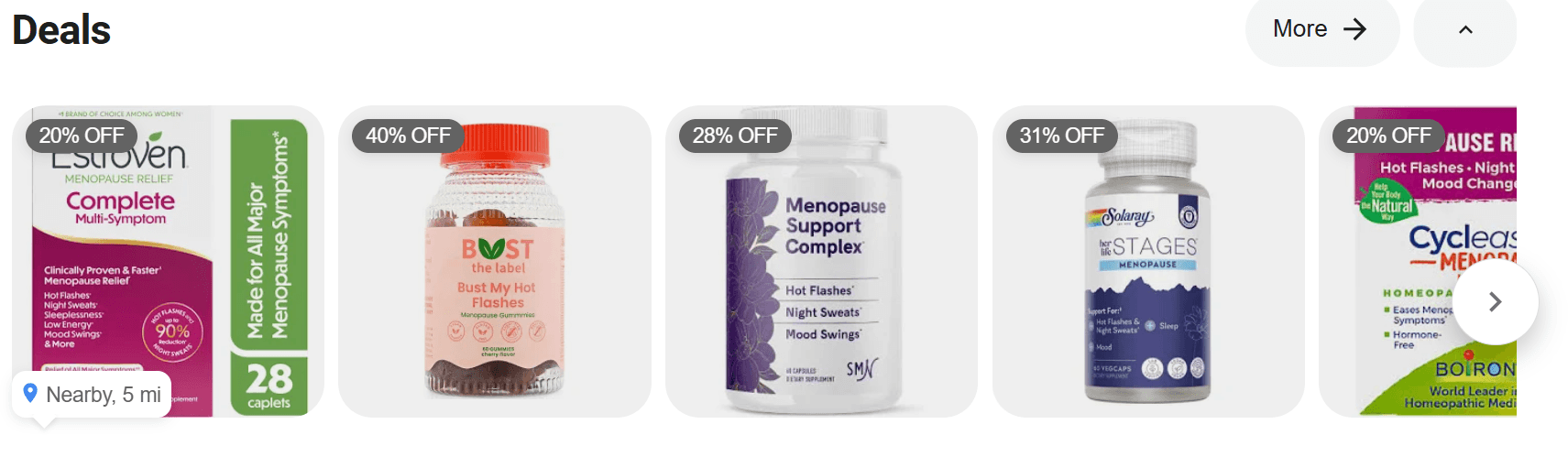
There are so many different options, “proprietary blends”, herbs, probiotics, vitamins, and minerals. How do we even start with this enormous category?
The Menopause Society includes a lot of options in their research here. Going back to the original paper, they look at the available research for the following supplements and the efficacy of each in its own separate category.
I highly encourage you, if you’re lured in by dropping your hard-earned cash on random supplements when your VMS get tough, to at least click through and look at this specific area of the position statements.
TLDR here’s what they look at in the paper:
💊 Soy metabolite “equol”
💊 Soy foods, soy extract
💊 Pollen extract
💊 Ammonium succinate
💊 Lactobacillus acidophilus
💊 Rhubarb
💊 Black cohosh
💊 Wild yam
💊 Dong quai
💊 Evening primrose
💊Maca
💊 Ginseng
💊 Labisia pumila/Eurycoma longifolia
💊 Chasteberry
💊 Milk thistle
💊 Omega-3s
💊 Vitamin E
💊 Cannabinoids
Again, so many choices and nothing really showing a strong benefit.
Does Black Cohosh Help with Vasomotor Symptoms?
To dig in one teensy bit before I wrap this puppy up, black cohosh is one of the most popular supplements in some of these blends. Almost every supplement-slinger offers their own branded version.
Black cohosh is made from the roots and rhizomes of the Italian Buttercup flower. It's native to the eastern US, and it’s been used in menopausal hormone support since the late 1800s. It was in a blend called Lydia Pinkham’s Vegetable Compound in the late 1800’s!
So, black cohosh has been around for a long time, and the research is really quite mixed. There are a ton of studies here on menopause symptoms; PubMed pulls up over 400 results. There's a 2012 Cochrane review with sixteen Randomized Controlled Trials that came up with “insufficient evidence overall for menopausal symptoms”, and for hot flashes specifically, no better than placebo.
The Menopause Society files black cohosh under “dietary supplements without demonstrated evidence of benefit.”
There’s another thing to watch for with black cohosh, and all supplements really, and that’s harm from liver toxicity.
Black cohosh has come under fire for this in the past. Around 2000, the US Pharmacopeial Supplements Expert Committee found 30 reports of liver toxicity that were possibly related to black cohosh. The committee issued a statement that black cohosh products carry a warning to discontinue use if you develop liver symptoms.
I am not “anti-supplement,” and I do recommend specific supplements across many categories when warranted. I do not think the research here supports taking a supplement for hot flashes or night sweats.
Just because you can buy it off the shelf does not mean it's more natural or effective. It might be easy to click “add to cart,” but what are you really getting in return?
Ready to find out what works for hot flashes and night sweats?
There’s strong evidence to support certain medications (beyond MHT) for help with VMS.
Two different behavioral health modalities, hypnosis and CBT, are both recommended to reduce VMS.
Make nutrition choices for VMS based on your own and your healthcare team’s discretion, knowing we don’t yet have robust evidence to support a single nutrition pattern for VMS.
Supplements for hot flashes are highly variable, the evidence shows conflicting results, and the placebo effect and potential harm are real things. Buyer beware!
As a Certified Nutrition Specialist® and Menopause Society Certified Practitioner, I’m here to help you navigate symptoms of neurodivergent menopause while looking out for your relationship with food and your body.
If you’re feeling overwhelmed by it all and would like a helping hand to guide you through some options, let’s chat. Please reach out here to book a free call.